Why Microsoft Ads bidding deserves a second look
On November 18, 2026, Microsoft Advertising rolled out what it calls the biggest upgrade to its bidding models in a decade. If you wrote off Microsoft Ads bidding years ago, this is a good moment to look again.
Plenty of advertisers treat Microsoft Ads as an afterthought: import the Google campaigns, set a small budget, check in once a quarter. The real question is whether the new models change the math for your business.
Key takeaways
- Microsoft rebuilt the models that predict whether a click turns into a conversion and what it is worth. It applies automatically.
- Microsoft reports about 10% more conversion value per click for Maximize Conversion Value and Target ROAS campaigns at a similar ROAS, based on its own August 2026 data.
- The gains depend on clean conversion data. Microsoft saw its largest gains among advertisers who sent actual transaction values.
- Run a structured test: at least 5 account conversions to start, target changes in 15% steps, and about 30 conversions in 30 days before you judge.
What changed in Microsoft Ads bidding on November 18, 2026?
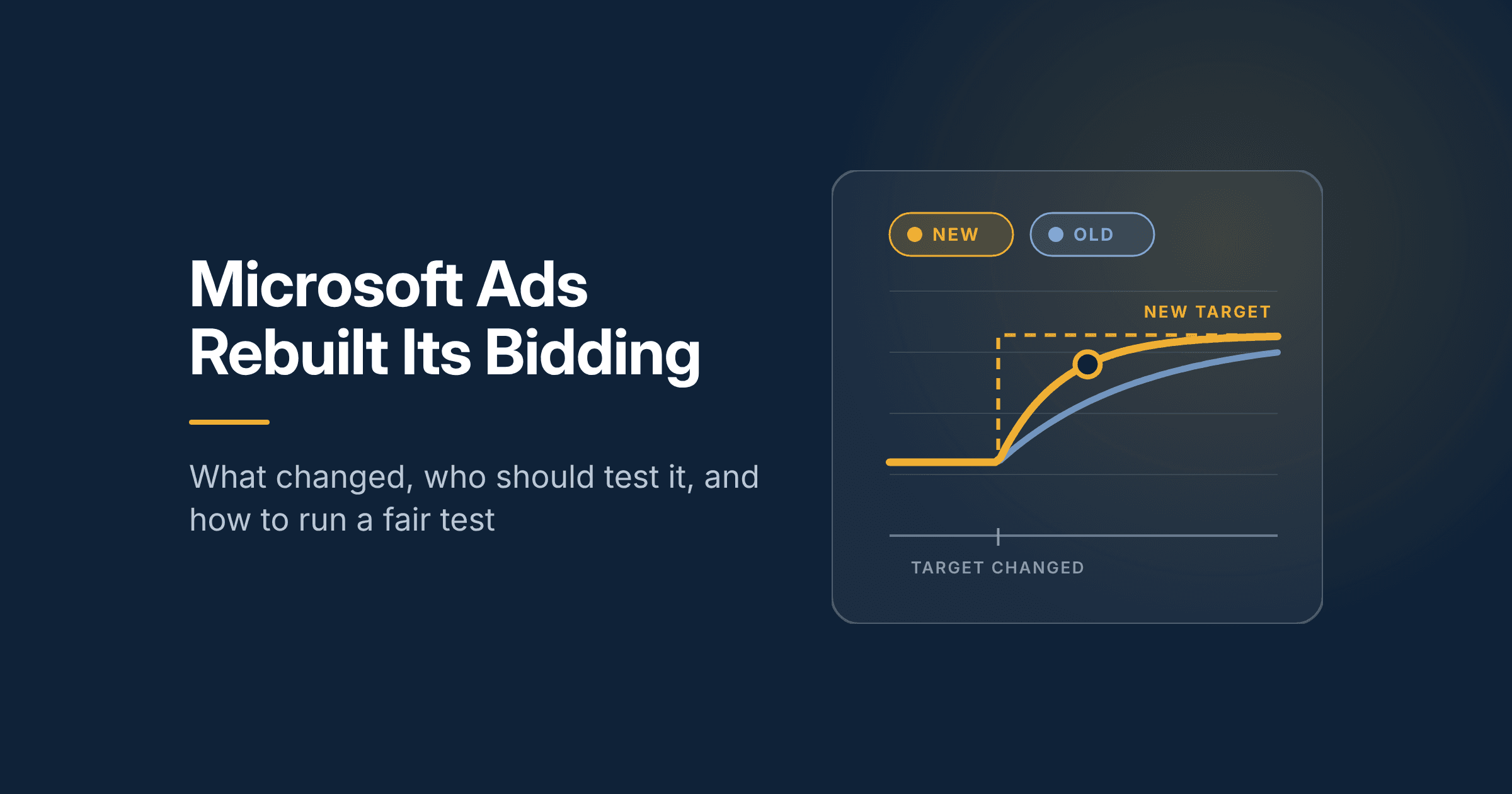
Microsoft rebuilt the models behind its automated bidding. They now use new user signals and a better way of valuing each conversion to predict whether a click will convert and what it is worth. Microsoft says bids adjust nearly twice as fast after a target change, and budgets pace more evenly.
Automated bidding is when the platform sets your bid in each auction based on a goal you give it, like a target cost per acquisition (CPA) or a target return on ad spend (ROAS). The model is the part that estimates how valuable each click is.
Microsoft listed three practical effects in its announcement, written by Principal Product Manager Carlo Buchmann:
- Campaigns hit CPA and ROAS targets more consistently, without giving up conversion volume or value.
- Bids react nearly twice as fast after you raise or lower a target.
- Budgets spend more evenly across the day, and campaigns reach full budget sooner.
Microsoft did not name the new signals. It called this "the first stage" and said more improvements are coming in 2027. There is no setting to turn on, so automated campaigns may start spending differently before you touch anything.
Which bid strategies benefit, and what results did Microsoft report?
Maximize Conversion Value and Target ROAS show the clearest gain. Microsoft says advertisers on those strategies saw about 10% more conversion value per click at a similar ROAS in August 2026. It also shared results for advertisers who switched strategies, which measure something different.
- Using Maximize Conversion Value or Target ROAS on the upgraded models: About 10% more conversion value per click, similar ROAS (August 2026)
- Switching Search campaigns from Target CPA to Target ROAS: About 8% more conversion value, similar ROAS (August to September 2026)
- Switching from Enhanced CPC to Maximize Conversions with a CPA target: About 18% more conversions, similar CPA (June to July 2026)
Read these with care. They are Microsoft's own data, with no sample sizes. Only the 10% figure describes the new models directly; the 8% and 18% figures describe advertisers who switched strategies.
The direction still matters. Microsoft is pushing value based bidding: bidding on what a conversion is worth instead of counting every conversion the same. Google and OpenAI are moving the same way. I covered the ChatGPT version in how ChatGPT Ads is changing bidding, and if you also run ads on ChatGPT, the same rules about conversion values apply there.
Is Microsoft Ads worth testing for your business now?
Microsoft Ads is worth testing if you already track conversions with real values, your Google search campaigns are profitable, and you can fund a 30 to 60 day test. If your tracking is thin or your Google account is not working yet, fix that first.
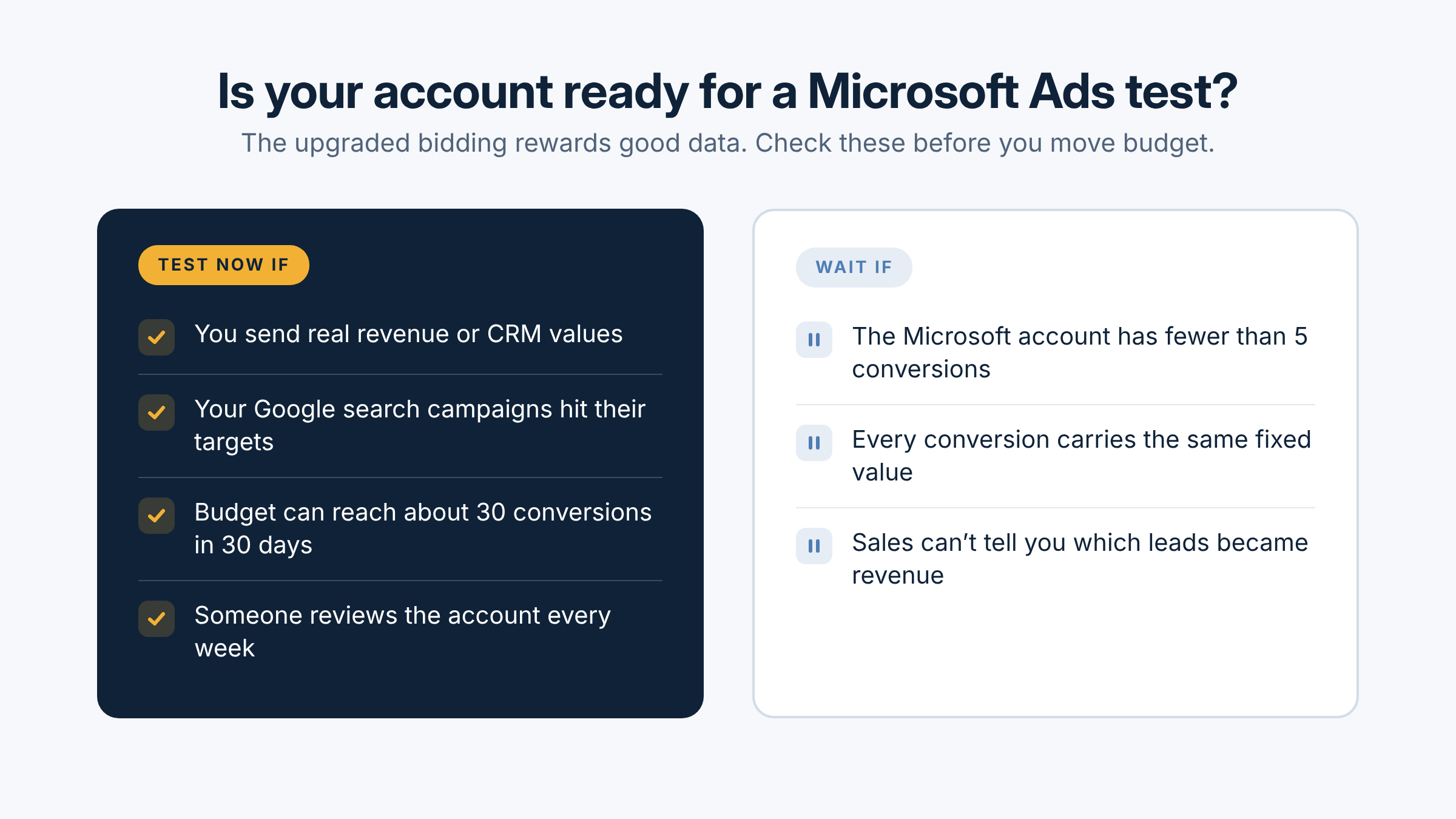
You're a good fit for a test if:
- You send real revenue or lead values, ideally pulled from your CRM.
- Your Google search campaigns hit their targets and you want more volume at similar efficiency.
- You can give the test enough budget to reach about 30 conversions in 30 days.
- Someone reviews the account at least weekly.
You should wait if:
- Your Microsoft account has fewer than 5 conversions. Microsoft suggests Enhanced CPC to build history first.
- Every conversion carries the same fixed value, so any ROAS you see is only an estimate.
- Your sales team can't tell you which leads turned into revenue.
How do I set up a fair Microsoft Ads bidding test?
Start with clean conversion tracking, pick a conversion based strategy once the account has at least 5 conversions, remove Max CPC caps, and then leave the campaign alone. Microsoft suggests about 30 conversions in 30 days at the campaign or portfolio level before you judge the results.
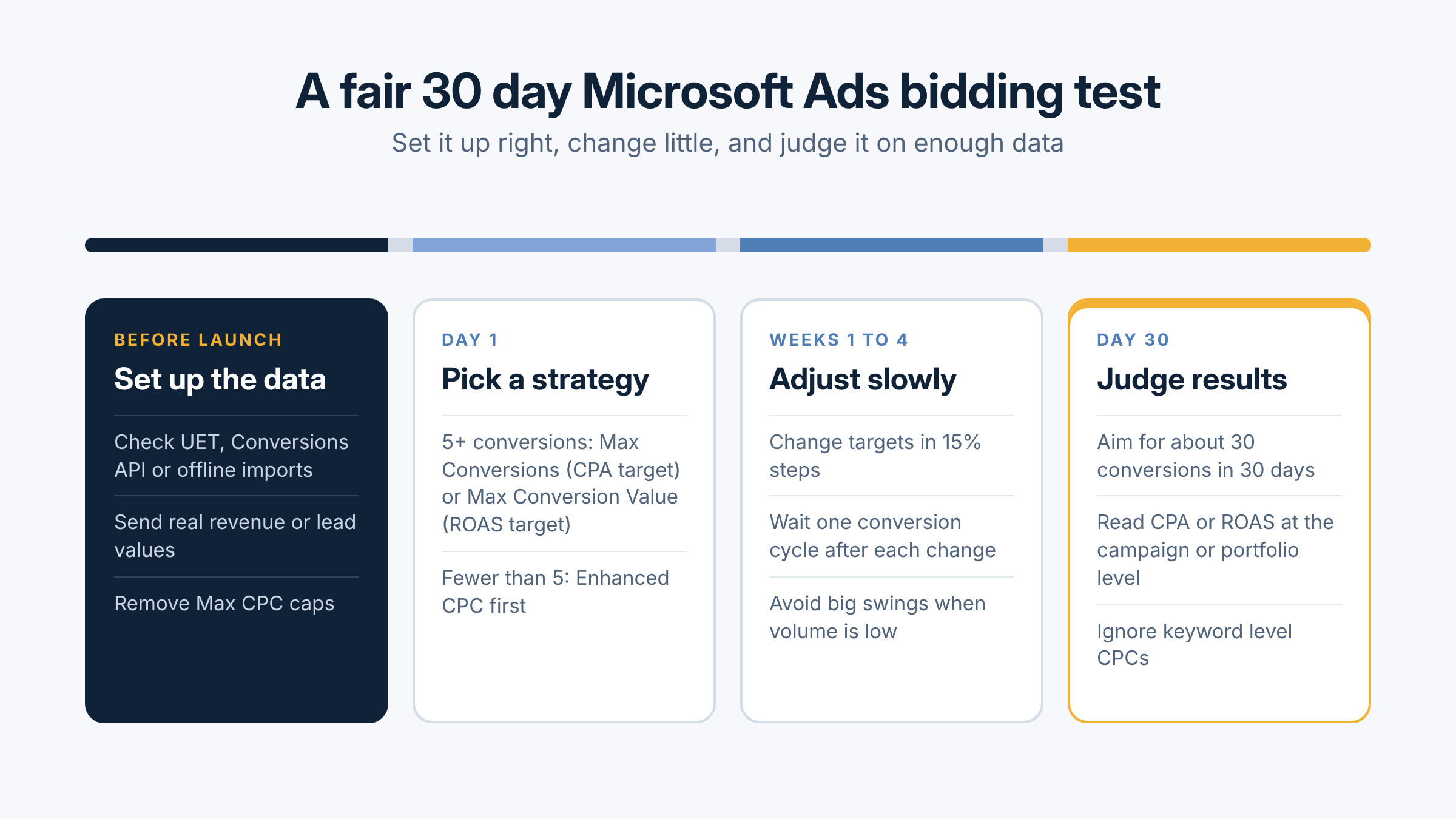
- Check your tracking. Microsoft recommends Universal Event Tracking (UET) as the main signal, with the Conversions API and offline conversion imports alongside it.
- Send real values. Compare reported conversion values against actual revenue. For lead generation, send an estimated value at the form fill, then update it as your CRM learns more. If your CRM is HubSpot, HubSpot management is usually where this gets fixed.
- Pick the strategy. With at least 5 account conversions, start new campaigns on Maximize Conversions with a CPA target or Maximize Conversion Value with a ROAS target. With fewer, use Enhanced CPC to build history first.
- Remove Max CPC caps. Microsoft now advises against them on automated campaigns, even above your average CPC, because a cap blocks bids the model would otherwise make.
- Change targets in 15% steps. Review each change after one conversion cycle.
- Judge at the campaign level. Look at conversions and CPA or ROAS for the campaign or portfolio, not keyword level CPCs.
Common mistakes to avoid with Microsoft Ads bidding
The biggest mistakes are judging too early, changing too much at once, and feeding the model weak conversion data. Each one can make a healthy campaign look broken.
- Calling it after two weeks. Faster bidding does not speed up your sales cycle. If buyers take a week to convert, you wait a week to see the effect of a change.
- Big target swings. A large CPA increase or ROAS cut opens auctions the campaign used to skip, which causes temporary volatility.
- Counting every lead the same. A newsletter signup and a demo request should not carry the same value. If they do, the model chases the cheap ones. I explain why in why more leads isn't the goal.
- Copying Google settings line for line. An import is a fine starting point, but bid caps and fixed values carried over from Google can hold the new models back.
Questions to ask your agency about Microsoft Ads
Ask whether your Microsoft campaigns use conversion based bidding, what values they optimize toward, and when someone last made a real change in the account. The answers show whether you're set up to benefit from this upgrade.
- Are our Microsoft campaigns on automated bidding, and which strategy?
- Do we send real revenue or CRM values, or a fixed number per conversion?
- Do any automated campaigns still have Max CPC caps?
- How many conversions did each campaign get in the last 30 days?
- What would a 60 day test look like, and how will we judge it?
If you want a second set of eyes on your Microsoft or Google setup, I'm happy to take a look. You can see how I approach paid media management, or contact me to talk through your account.
Frequently asked questions
What is the Microsoft Ads bidding upgrade?
On November 18, 2026, Microsoft Advertising rebuilt the models behind its automated bidding. They predict more accurately whether a click will convert and what it is worth. The upgrade applies automatically and is reaching more accounts over time.
Do I need to change anything to get the new Microsoft Ads bidding models?
No. The upgrade applies on its own to campaigns that use automated bidding. To get the most from it, Microsoft recommends conversion based strategies, real conversion values, and removing Max CPC caps.
How many conversions do I need for automated bidding in Microsoft Ads?
Microsoft recommends conversion based bidding for new campaigns once the account has at least 5 conversions. To judge performance, it suggests about 30 conversions in 30 days at the campaign or portfolio level.
How long should I test Microsoft Ads before deciding?
Plan on at least 30 days, and longer if your sales cycle runs more than a week. Microsoft recommends waiting one to two conversion cycles after a major change before you judge the results.
Is Microsoft Ads bidding the same as Google Ads Smart Bidding?
Both set bids toward a CPA or ROAS goal for you. Microsoft says its bidding treats targets as directional levers and can beat them even when a campaign is limited by budget.