Your Google Ads account may have changed without anyone touching it
If you run Google Search ads, there is a good chance some of your campaigns now work differently than they did in August. Starting September 1, 2026, Google began moving certain Search campaigns to AI Max automatically. A second round, covering Dynamic Search Ads, is set for February 2027.
Many business owners haven't heard about it. Google announced it through help pages, developer posts, and an account email that's easy to miss.
The change isn't good or bad on its own. But it does shift who decides which searches trigger your ads, what your ads say, and which page people land on. Here's what changed and what I'd check.
What AI Max actually does
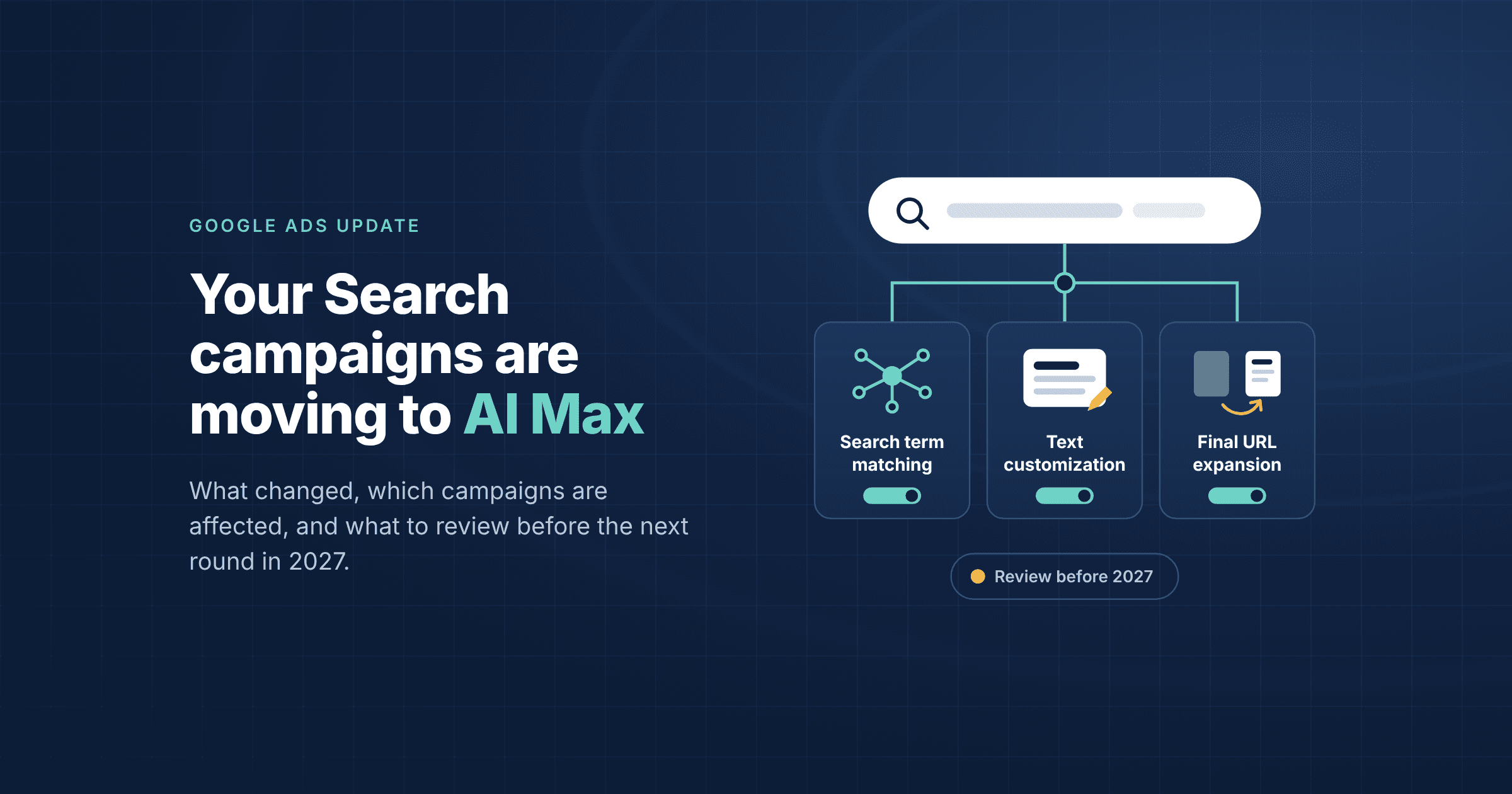
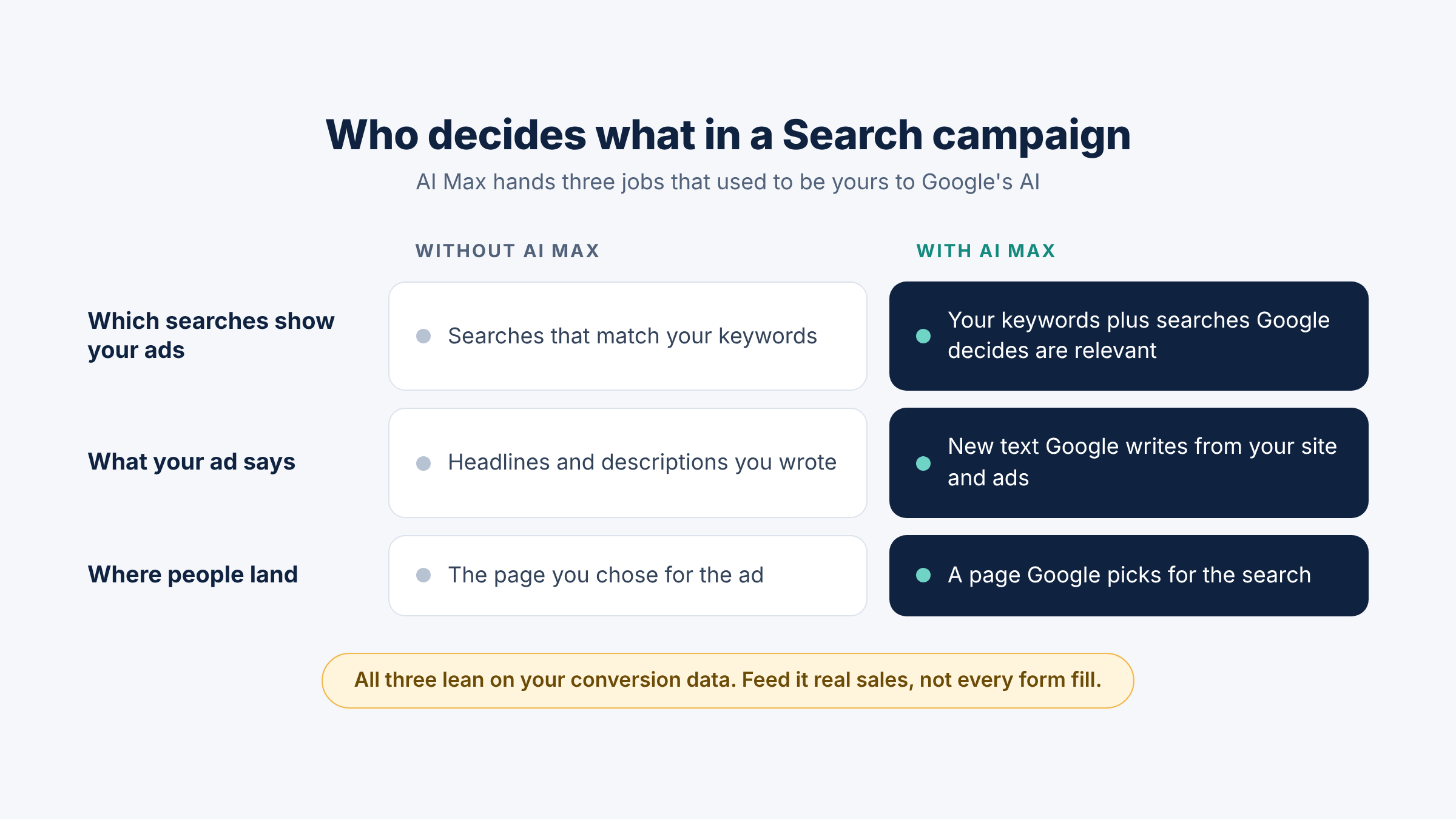
AI Max is a set of settings inside a regular Search campaign. It hands three jobs that used to be yours over to Google's AI:
- Search term matching. Google uses your keywords, ads, and website to find searches it thinks are relevant, including ones your keywords would never have matched.
- Text customization. Google writes new headlines and descriptions based on your site, landing pages, and existing ads.
- Final URL expansion. Google can send a visitor to a different page on your site than the one you chose, if it decides that page fits the search better.
Google's help docs say these features need a conversion based Smart Bidding strategy to work well. So AI Max is only as smart as the conversion data you feed it. If your account counts form fills that never turn into sales, AI Max will chase more of them.
That's why so much of the work in paid media has shifted. The tools are automated. The judgment about what to feed them isn't.
Which campaigns are affected, and when
Whether a campaign moved depends on settings chosen in the past.
- Automatically created assets. Starting September 1, 2026. Search term matching and text customization are turned on.
- Campaign level broad match. Starting September 1, 2026. Search term matching only.
- Dynamic Search Ads. New DSA campaigns are blocked in January 2027, and the rest are upgraded in February 2027. Details on which AI Max features turn on are still to come.
Google says the September upgrades are set up to closely mirror the old settings. For broad match campaigns, that means Google won't rewrite your ads or swap your landing pages by default. You can read Google's own note on the broad match setting.
If you're not sure which settings your account uses, find that out first.
What I'd check in your account this month
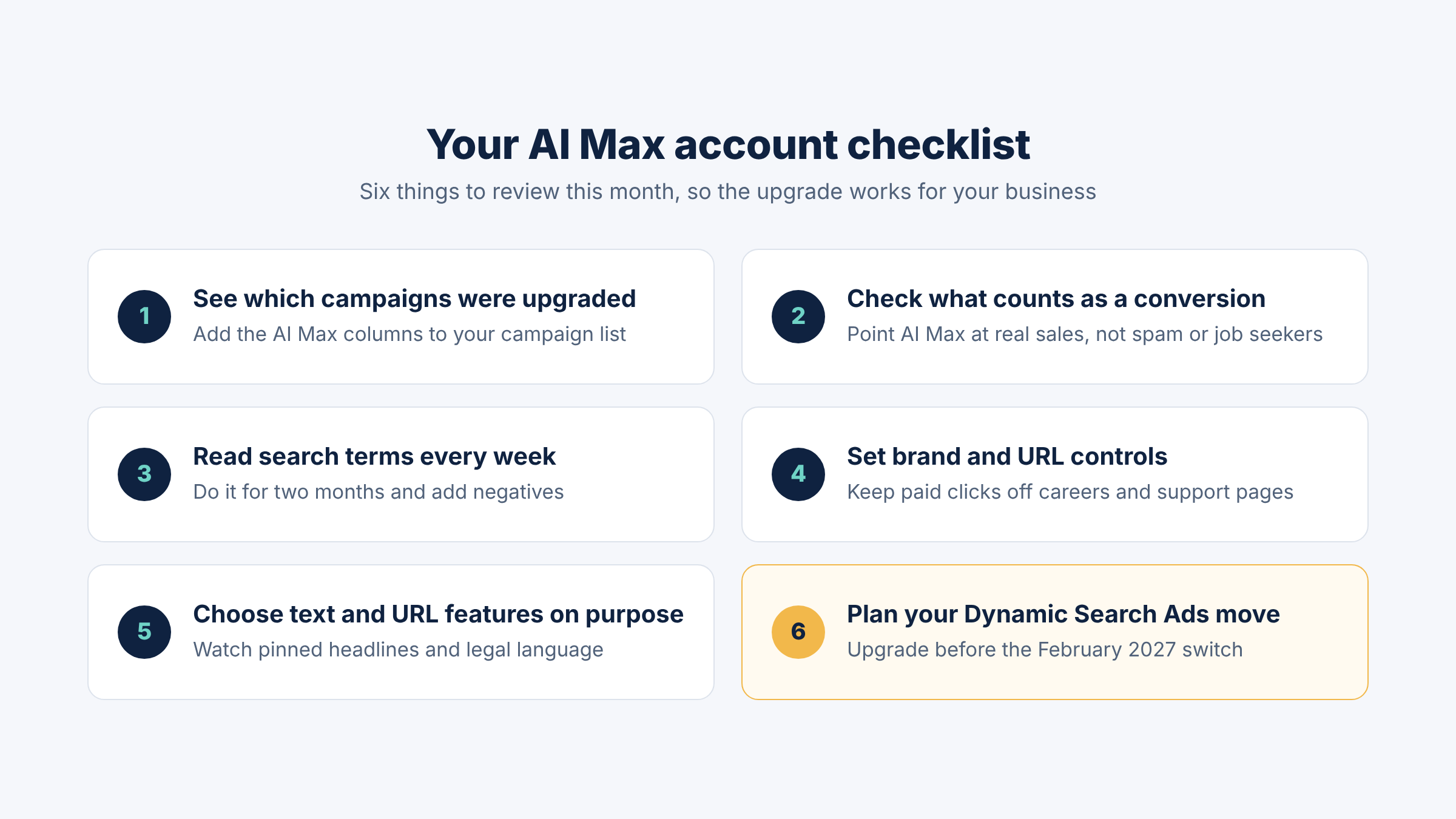
You don't need to undo the upgrade. You need to make sure it's working for your business and not just for Google's metrics.
- See which campaigns were upgraded. In the campaign list, add the AI Max columns. You'll see which features are active.
- Check what counts as a conversion. AI Max optimizes toward whatever you call a conversion. If that's every form fill, including spam and job seekers, fix that first. I wrote more about this in why more leads isn't the goal.
- Read your search terms report every week for the first two months. Look for searches that will never buy from you and add them as negative keywords.
- Set brand and URL controls. Brand exclusions keep your ads off searches you don't want. URL exclusions keep Google from sending paid clicks to pages like careers, blog posts, or support.
- Turn on text customization and URL expansion on purpose, or not at all. When final URL expansion is on, Google may skip your pinned headlines. If you have required legal or compliance language, that matters.
- Plan your Dynamic Search Ads move before February. Google recommends upgrading on your own schedule before the automatic switch.
Clean campaign and ad group names make this review much faster. If yours are a mess, start with our guide to Google Ads naming conventions.
Questions to ask whoever runs your Google Ads
If an agency or someone in house manages your account, ask them these:
- Which of our campaigns moved to AI Max in September, and what changed in results since?
- What are we counting as a conversion, and does it connect to closed revenue in our CRM?
- What new search terms are we paying for now that we weren't before?
- Which pages have we excluded from final URL expansion, and why?
- What's our plan for Dynamic Search Ads before February 2027?
Tying ad spend to real revenue usually means connecting Google Ads to your CRM, which is a big part of how we approach HubSpot management.
If you'd like a second set of eyes on your account, reach out. I'm happy to walk through what changed and what I'd do next.
Frequently asked questions
What is Google Ads AI Max?
AI Max is a set of features inside Search campaigns. It uses Google's AI to widen which searches show your ads, write ad text, and choose landing pages.
Can I turn AI Max off after the upgrade?
Yes. You can turn off individual features like text customization and final URL expansion in campaign settings. Turning off text customization also turns off final URL expansion.
Will AI Max lower my cost per lead?
It depends. Google reports gains in its own data, but independent tests have been mixed. Results depend heavily on the quality of your conversion data.
What happens to Dynamic Search Ads?
New DSA campaigns can't be created starting January 2027. Remaining DSA campaigns are scheduled to be upgraded automatically in February 2027.
Does AI Max matter for AI search?
Yes. Google said at Google Marketing Live 2026 that ads in AI Mode will run through Performance Max and AI Max. If you're thinking about AI search visibility, your paid setup is now part of that picture.