Google Ads Naming Conventions: The Complete System
Most marketers don’t think about naming conventions until they try to run a report… and realize nothing lines up. Campaigns follow no structure. Ad groups are labeled inconsistently. UTMs don’t match anything in the account.
And when leadership asks simple questions—Which campaigns influenced revenue?
Which geo converts best?—the answers take hours of manual cleanup.
A clean naming system solves all of that. With rising CPCs, increasing automation, and more emphasis on CRM-based attribution, structured naming isn’t optional anymore. It’s a competitive edge.
Below is the complete system for building a naming framework that scales without adding complexity.
Why Naming Conventions Matter More Than Ever
Modern paid media relies on clean data. When campaign names match UTMs, analytics, and CRM fields, reporting becomes instant and accurate. When they don’t? Teams lose visibility, waste budget, and can’t attribute what’s working.
A strong naming framework helps you:
- Improve tracking accuracy across Google Ads, analytics tools, and CRMs.
- Strengthen attribution so SQLs and revenue map back to the right campaigns.
- Speed up optimization, especially across regions, audiences, or funnel stages.
- Simplify reporting so dashboards automatically group data correctly.
If naming is inconsistent, scaling becomes harder, decision-making slows, and your data becomes unreliable.
The Core Problem: Most Accounts Use “Human Language” Instead of Structure
Marketers often create names like:
- Brand – March – Search
- Q4 Testing Campaign
- Midwest Retargeting
The issue?
These names don’t encode the information needed to sort, analyze, or group campaigns at scale.
A naming system needs to be machine-readable, not just human-friendly.
The Google Ads Naming Framework
Below is a structure you can apply across Campaigns, Ad Groups, Ads, and UTMs so everything stays aligned.
1. Campaign Naming Structure
Recommended format:
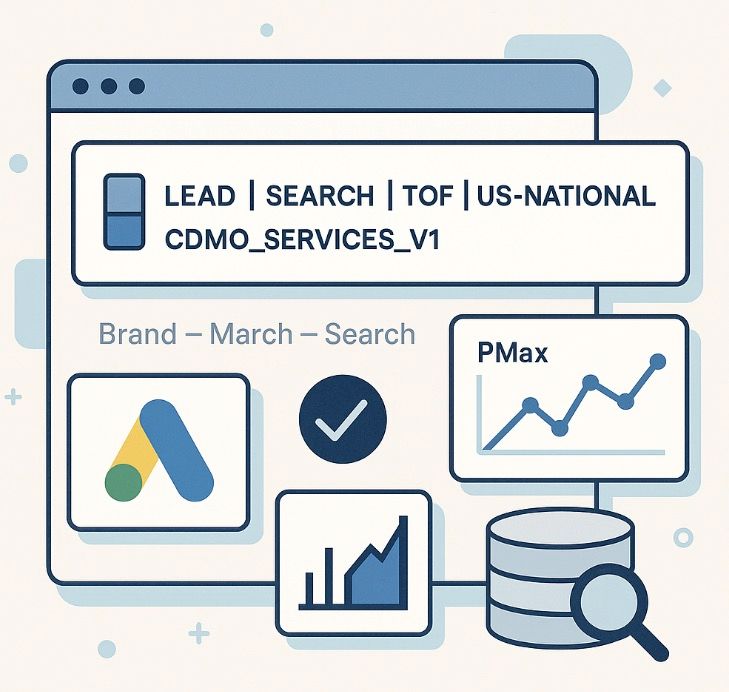
Objective | Network | Funnel | Audience/Geo | Offer or Product | Version
Example:
LEAD | Search | TOF | US-National | CDMO_Services | V1
Breakdown:
- Objective — LEAD, DEMO, PURCHASE, AWARE
- Network — Search, PMax, Video, Display
- Funnel Stage — TOF, MOF, BOF
- Audience/Geo — US-West, IL-Chicago, Lookalike, Remarketing30
- Offer/Product — High-level product or service
- Version — V1, V2, etc. for iteration
This structure keeps names short, structured, and easy to use in dashboards or pivot tables.
2. Ad Group Naming Structure
Recommended format:
MatchType | Theme | Variant
Examples:
- EX | cdmo services | core
- PH | ngs providers | competitor
Why this matters:
Match type + theme lets you instantly compare keyword buckets, intent groups, and testing variants.
3. Ad Naming Structure
Ads should label the angle, not the full copy:
Angle | Format | Version
Examples:
- ValueProp | RS | V1
- CTAForward | ETA | V2
- PainPoint | RS | V1
This makes creative testing measurable and repeatable.
4. UTM Naming Must Match Your Account Naming
This is where most teams break the system.
Campaign UTMs should mirror your campaign naming convention:
utm_source=google
utm_medium=cpc
utm_campaign=LEAD_Search_TOF_US-National_CDmoServices_V1
utm_term={keyword}
utm_content={ad_id}
When UTMs follow the same structure, your CRM, GA4, Looker Studio, and revenue dashboards stay clean and aligned.
5. Universal Naming Rules Every Team Should Follow
1. No spaces
Use hyphens or underscores — this prevents broken UTMs and tagging issues.
2. Avoid dates in campaign names
Dates force unnecessary rebuilds and break evergreen reporting.
3. Keep names under ~70 characters
Long names get clipped in several tools.
4. Avoid internal or vague labels
“Test,” “Brand,” “Q4,” “General,” etc. don’t help reporting.
5. Make the system repeatable
Every new campaign should follow the same pattern automatically.
6. Examples of Bad vs. Good Naming
Bad (common in most accounts)
- Q1 Search – Conversions
- Brand Campaign – Midwest
- PMax – Testing New Audiences
Good (structured & scalable)
- LEAD | Search | BOF | US-IL | brand_term | V1
- LEAD | Search | TOF | US-Midwest | service_kw | V2
- AWARE | PMax | TOF | US-National | broad | V1
You can instantly understand the campaign’s purpose, audience, and testing stage.
7. How Clean Naming Improves Reporting & Attribution
Structured naming unlocks:
- Cleaner funnel reporting (TOF → BOF)
- Clearer regional comparisons
- More accurate offline conversion mapping
- Faster creative testing cycles
- Better multi-channel attribution
The more cleanly everything is labeled, the more your reporting tools can do the heavy lifting for you.
8. A Starter Framework (Copy/Paste for Your Team)
Use this for an easy rollout:
Campaign:
OBJECTIVE | NETWORK | FUNNEL | GEO | PRODUCT | V#
Ad Group:
MATCHTYPE | THEME | VARIANT
Ad Name:
ANGLE | FORMAT | V#
UTM Campaign:
OBJECTIVE_NETWORK_FUNNEL_GEO_PRODUCT_V#
This structure scales cleanly across any industry or budget size.
Final Thoughts
Google Ads gets more automated every year, but the one thing automation can’t fix is messy data. Clean naming conventions give you better attribution, clearer reporting, and faster optimization. They also keep your entire team aligned and remove hours of manual cleanup.
If your account is already messy, now is the time to fix it before you launch something new.